
UNCOVER THE REAL YOU
ASK YOUR DOCTOR ABOUT MAGSTIM TMS THERAPY TODAY
APPROXIMATELY 58% OF PATIENTS WITH TREATMENT RESISTANT MDD RESPOND POSITIVELY TO TMS THERAPY
FEEL LIKE YOURSELF, AGAIN
Time has changedLiving with depression is hard, but Major Depressive Disorder (MDD) can be especially painful when one treatment after another doesn’t help. You lose hope. Will you ever feel better?
Finding the right treatment can take time but TMS may be the treatment that will make you feel like yourself again.
Magstim®, is the brains behind TMS and our equipment is used in the majority of clinical studies worldwide.
- Carpenter LL, Janicak PG, Aaronson ST, Boyadjis T, Brock DG, Cook IA, et al. Transcranial Magnetic Stimulation (TMS) for major depression: a multisite, naturalistic, observational study of acute treatment outcomes in clinical practice. Depress Anxiety 2012;29:587–96.
- Rossi, S., Hallett, M., Rossini, P. M., Pascual-Leone, A., & Safety of TMS Consensus Group (2009). Safety, ethical considerations, and application guidelines for the use of transcranial magnetic stimulation in clinical practice and research. Clinical neurophysiology: official journal of the International Federation of Clinical Neurophysiology, 120(12), 2008–2039. doi:10.1016/j.clinph.2009.08.016. The FDA grants clearance to manufacturers to market devices for specific indications,
after safety and efficacy have been demonstrated, by issuance of either a 510(k) or PMA clearance
WHAT IS TMS ?
Transcranial Magnetic Stimulation (TMS) is a series of repetitive, brief and highly focused magnetic pulses, designed to stimulate brain cells
HOW DOES IT WORK?
In depressed patients, the electrical activity in certain areas of the brain is shown to be reduced. TMS targeted in these areas, reawakens these cells, increasing brain activity to appropriate levels.

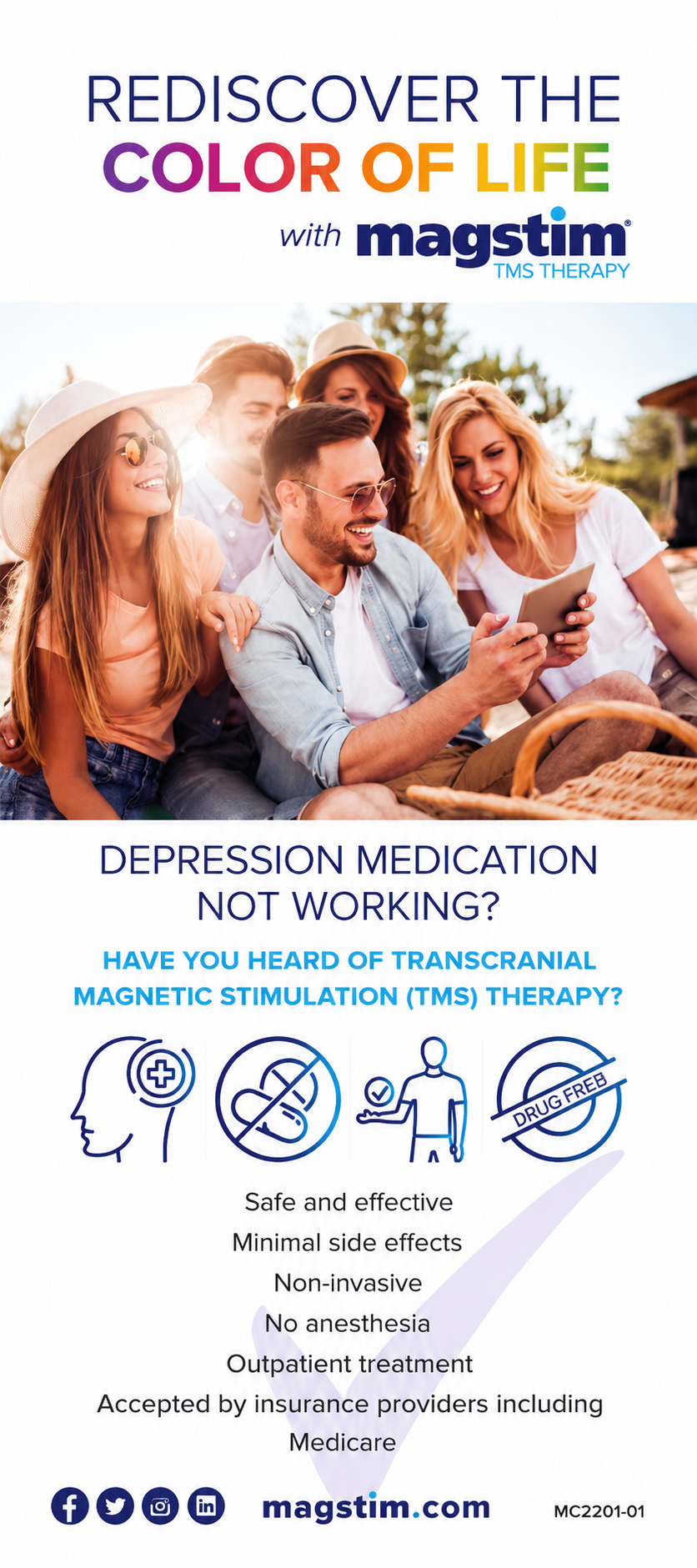
TMS is non-invasive and has very few side effects.
WHAT IS THE DIFFERENCE BETWEEN TMS AND ANTIDEPRESSANTS?
TMS is typically prescribed when antidepressants have failed, or the side effects are intolerable. Antidepressants are systemic, which means that the medication is absorbed into the blood stream. This can cause numerous side effects. TMS is a non invasive, outpatient procedure with no systemic side effects.
POSSIBLE SIDE EFFECTS
TMS is a safe and well tolerated treatment that is not associated with any of the systemic side effects typically experienced with antidepressants. Clinical studies show that the most common side effects are mild to moderate scalp discomfort and mild headaches, both of which are short term2.
WILL TMS BE COVERED BY MY INSURANCE?
TMS is covered by most insurance providers including Medicare (and also by Medicaid in some states). Prior authorization is typically required for insurance coverage - your physician will manage this process.
Short-term transient side effects have been noted in some cases. There have been infrequent reports of seizures associated with TMS. The
estimated seizure risk is 0.03% of treatment sessions, or <1% of patients.
IS TMS AN OPTION FOR ME?
In the US, TMS therapy is approved for adults with Major Depressive Disorder (MDD), who have failed to achieve satisfactory improvement from prior antidepressant medication in the current episode. This means that if you have been diagnosed with MDD and medications are not working, or the side effects are intolerable, you should ask your doctor
about TMS.

Your current physician can refer you to a TMS provider to assess whether TMS is right for you.
WHAT MIGHT I EXPECT DURING MY TMS TREATMENT?
TMS is performed in a doctor’s office or clinic. Treatment sessions last from 3 - 37.5 minutes and are typically performed 5 days per week, over a six-week period.
You will be seated in a comfortable chair, some measurements may be taken and you may be provided with earplugs. Your doctor will position the magnetic coil on your head and treatment will begin. You may feel a
moderate tapping on your head under the treatment
coil and you will remain awake and alert throughout treatment.
Following your session, you will be able to drive home and you can resume normal activities for the
rest of the day
WHAT DOES TMS FEEL LIKE?
The magnetic coil which delivers TMS is positioned on the head. You will hear a clicking sound and feel a tapping sensation on your head when the magnetic pulses are delivered.
